How to Transcribe Your Podcast (and Why You Should)
Your podcast transcript can help you build bridges with new audiences while showing your existing audience respect for their attention.


The day Apple announced that it would transcribe podcasts in its app, my heart leapt for joy. Then I wondered about accuracy, and my heart sank. Now PocketCasts and Spotify offer transcription too. When directories and apps auto-transcribe episodes, it's convenient for podcasters. But it doesn’t replace owning the words attached to your show. Creating your own transcript keeps your content accurate, accessible, and aligned with how you promote it. Let me show you how to transcribe your podcast to make it help your show grow.
Why You Should Transcribe Your Podcast
Generating and editing your own transcript does more than prevent moments where you say, “you might want to try linking that doc over there,” but the audience reads, “you might want to try licking that duck over there.” It affects how clearly your podcast reaches new listeners, how accurately it’s represented, and how easily your work can travel beyond the audio.
Accessibility & Inclusion
Transcripts make your podcast accessible to people who are deaf or hard of hearing, but that’s not the only audience they serve. They also help listeners who are neurodivergent, not fluent in your podcast’s language, or who simply prefer reading. A transcript quietly says, this show wants you here.
Accuracy & Responsibility
Your transcript is a written record of what you actually meant. Editing it once per episode is a small effort that prevents misunderstandings, misquotes, and avoidable embarrassment. Accuracy is part of taking responsibility for your ideas.
Promotion & Repurposing
A single, accurate transcript becomes the source of truth for clips, captions, pull quotes, blog posts, newsletters, and press. When people can quote you easily and correctly, your work travels further without getting distorted along the way.
Search & Discoverability
Most search engines and podcast apps can’t listen to audio, but they can read transcripts. An accurate transcript helps your episodes surface in search results without requiring you to become an SEO expert.
In short: a transcript isn’t busywork. It’s the foundation that lets your podcast reach more people, more clearly, with less friction.
When Transcription Fits in Your Podcast Workflow
Transcribe your podcast after you edit the dialogue, but before you upload it to your media host. I use an automated transcription service (and you certainly should, to save time). But once the service has generated your transcript, read it, identify any errors, and correct them.
Why this stage? Because:
- Your final audio file is the last word of your episode’s message. You’ve cut out any digressions, filler words, or extraneous material that can distract from your message, so there’s less to process. This straightforward version is the one you want people to remember.
- Polishing the final version of your podcast transcript before uploading means that you won’t have to make multiple corrections later. Different platforms may use different transcription software, leading to varying discrepancies.
- Whether your promotion workflow happens before or after you publish your episode, you want to use the same transcript for reference. Keep it ready for your show notes, video clips, social media posts, and other publicity efforts.
Your podcast hosting service may transcribe your podcast for you when you upload it. But you can still read it and edit it to make sure it matches your intentions. Download it and keep a copy for reference.
If what you say in your podcast matters to you, transcription should come before the recording leaves your desk.
Podcast Transcription With Alitu
Our mission at Alitu has always been to be the quickest and easiest podcast editing platform on the market. But we've also built in every other tool you need to run a show, including call recording, hosting, and automatic transcription.
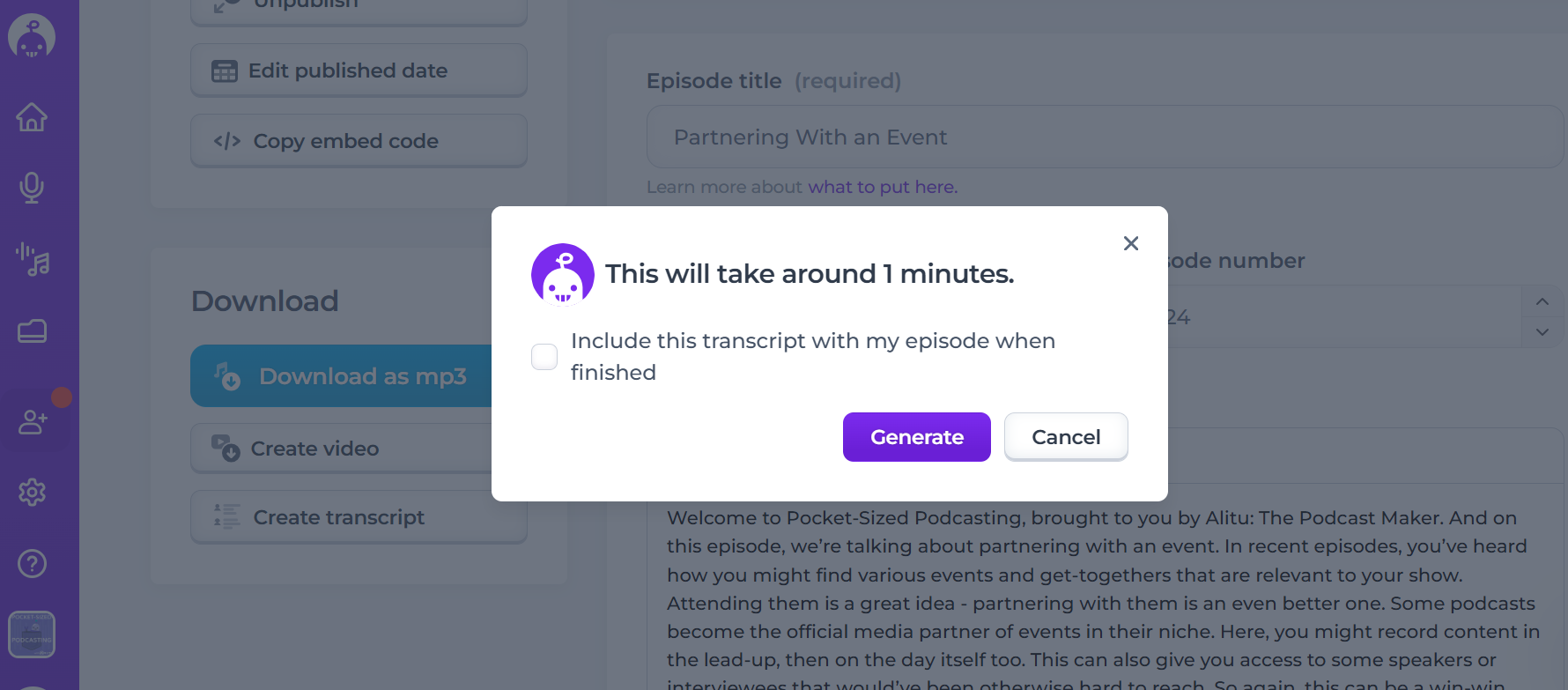
With Alitu, you can generate a transcript automatically and attach it directly to your RSS feed if the accuracy is good enough. If you want more control, download the transcript as a Word document, make your edits, then upload the finished version to your website as a PDF (or text file), which you can then link to in the show notes. You can also upload the finalized transcript to Apple Podcasts Connect, where it will replace Apple’s automatically generated transcript for that episode.
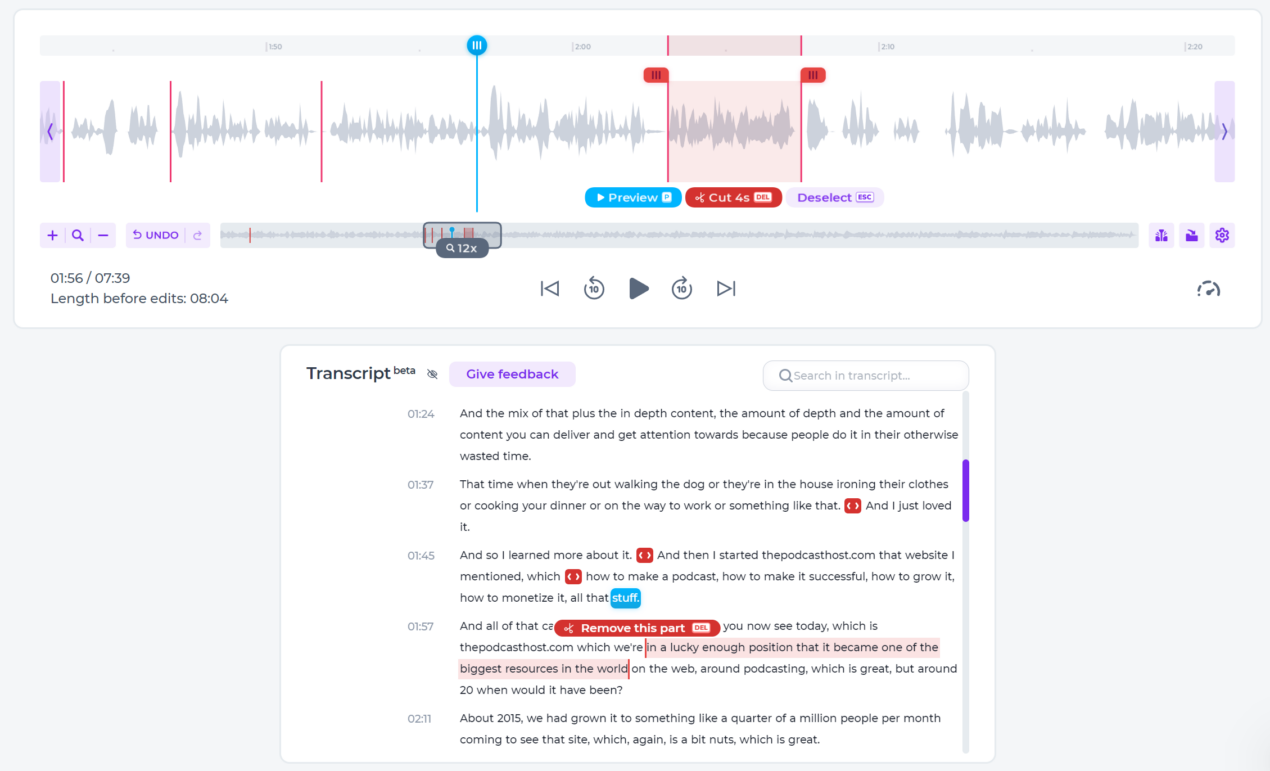
Alitu's automatically generated transcriptions also come in handy during podcast production. With text-based editing, you can cut out sections of the transcript, and it'll delete the corresponding audio, too!
Free Podcast Transcription Tools
If you want to experiment with transcription before paying for a dedicated tool, these two options are useful starting points. Neither is built specifically for podcasting, but both can work in limited, well-defined scenarios.
Otter.ai
Otter.ai offers up to 300 minutes of free transcription per month and includes automated summaries with key takeaways. The limitation is strict: the free tier allows only three lifetime audio file uploads. That makes it best for quick experiments, or for podcasters who already use Otter for meetings and want to test transcription without adding another tool.
Rev.com
Rev’s free tier includes 45 minutes of AI transcription per month, with a stronger focus on accuracy than volume. It is a good fit when correctness matters more than throughput, such as legal, technical, or research-heavy shows, but it will not scale for regular weekly episodes.
How to Get the Most Out of Your Podcast Transcript
Your podcast transcript isn’t just an accessibility add-on; it’s the foundation for how your episode is shared, discovered, and reused. Here are some good ways to make it work harder for you.
Make Transcripts Available to Your Audience
Publish your transcript on your podcast website, and link to it from your show notes. Some podcasters post their transcripts on Patreon or another crowdfunding site, as a free asset. It’s a good reason for audiences to visit your crowdfunding site, and then you can tempt them with the possibility of ad-free or bonus content.
The simplest way that I’ve found to share transcripts is:
- Save them in a Google Drive folder
- Share a view-only link
- Use this link in your show notes and blog posts.
I’ve also received email requests for transcripts in the past, and having that link ready to paste into a reply makes my life easier.
No matter how you share your transcripts, don’t charge money for them. Paywalling your transcripts doesn't help accessibility. Some podcasters ask for an email address in exchange for the transcript, but this point of friction won't help your podcast’s SEO.
Use Transcripts to Support Promotion & Clips
You can use your transcript for:
- Pull quotes in your podcast media kit, press releases, blog posts, and social media
- Ensuring closed-captions in YouTube are accurate
- Selecting the most appropriate moments for clip-making tools, such as OpusClip.
When the words your audience reads match your intent, your promotion reaches the audience you want to meet. Don't let automation errors drive your promotion strategy into a wall.
Podcast Transcription Builds Bridges
Automatic transcription saves podcasters time and effort; there’s no doubt about that. But taking responsibility for your podcast’s words and ideas is more important.
Don’t get me wrong, I’m thrilled that Apple, PocketCasts, and Spotify generate transcripts for podcasts. They’re doing their due diligence as best they can. But there’s no way that any podcast platform can provide human-verified accuracy for the thousands of new podcast episodes published every day.
Your podcast transcript can help you build bridges with new audiences while showing your existing audience respect for their attention. And, your transcript prevents future misunderstandings, ensuring your show leaves a digital legacy of which you can be proud.
Taking responsibility for your podcast’s words doesn’t have to slow down your podcast workflow. Not only does Alitu transcribe your podcast, but it also removes annoying background noises, removes "uhs" and "ums," and makes your voice stand out. Alitu streamlines your process, so you can focus on what your podcast says, instead of whether or not it communicates clearly. Try it free for seven days, and let us know what you think.
